
Master Index
Substack Archive
Next Scene: The Long Way West
Without a Handler
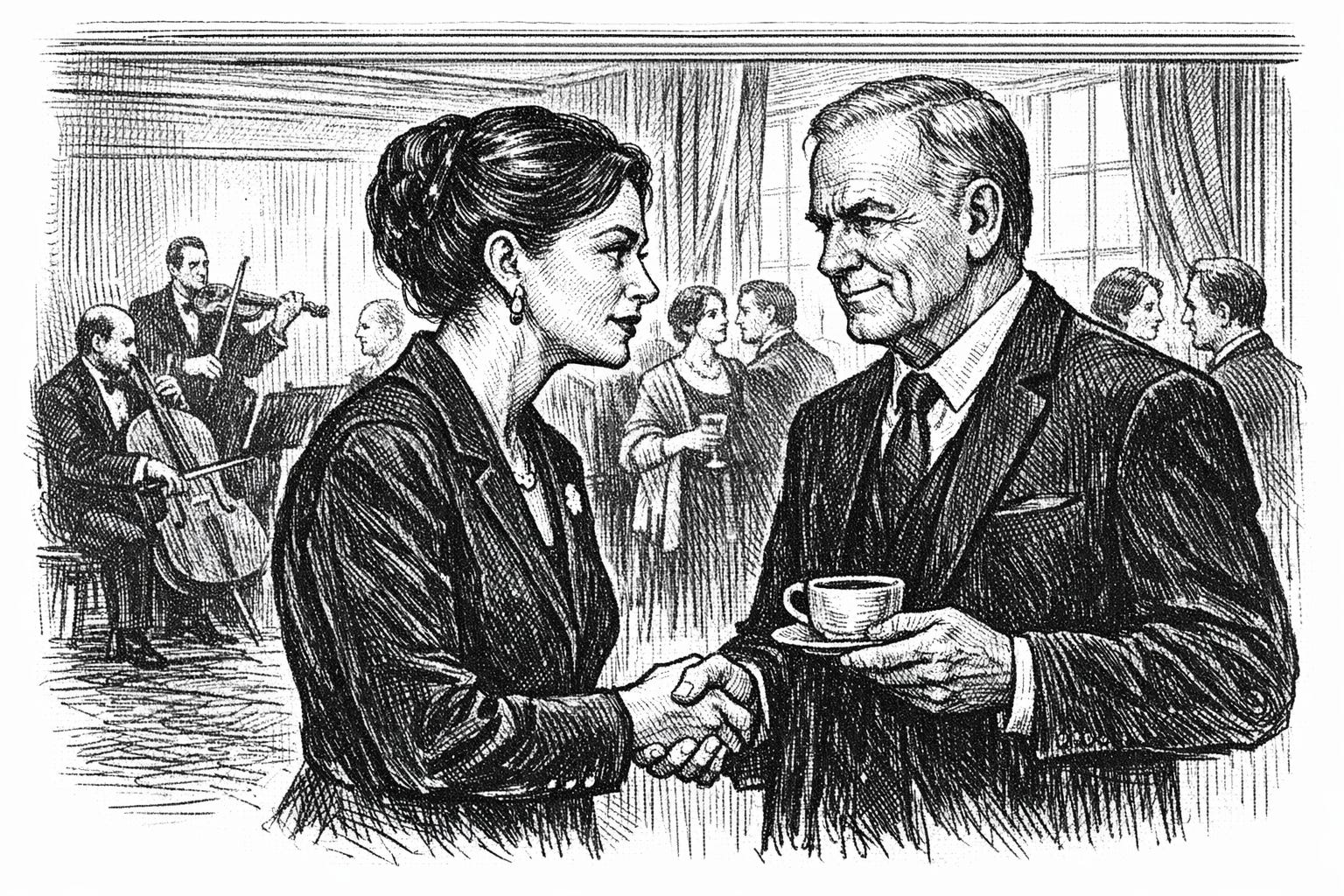
The reception was Lockheed Martin’s, which meant good wine, careful conversation, and the usual mix of Hill staffers, foreign defense attachés, and industry figures who understood that the real business of Washington happened in rooms like this one. Somewhere toward the back, a string quartet was working through Schubert’s “Death and the Maiden.”
The Ukrainian ambassador, Darya Kovalenko, had spent thirty minutes working the room before she found Senator Keane near the windows, coffee in hand, ignoring the wine entirely. Ray Decker, Keane’s expert on defense, stood a half step behind him, close enough to hear everything and far enough back to be mistaken for furniture by anyone who didn’t know better.
“Senator,” Kovalenko said. “I was hoping to find you without a handler.”
Keane smiled. “I fired my last one in 2019. Haven’t replaced him.”
They shook hands, and Kovalenko moved them a half step away from the nearest cluster of guests without making it obvious. Decker turned a bit to make sure he could hear.
“I will be direct,” she said quietly. “We have a proposal that Lockheed Martin is not ready to hear. But I believe you are.”
Keane said nothing, which was his way of saying, ‘Go on.’
“Ukraine has developed a generation of drone and counter-drone systems that NATO partners want. The technology works. The doctrine works.” Kovalenko turned her glass slowly. “We have already licensed production across Europe.”
She paused and listed them. “Germany, the United Kingdom, Denmark, the Baltics. The systems are being built. The problem is the same in every facility. Chinese components are somewhere in the chain—Taiwanese fab. Mainland sourcing two or three tiers down. Beijing knows exactly what we are building and exactly where our dependencies are. One policy decision in Zhongnanhai and the supply chain stops. We lose the production. We lose the war.”
She looked Keane in the eyes. “We will not embed a Chinese dependency in the core technology of our defense. That is a line we do not cross. Our European partners understand the problem, but none of them has found a solution. You have the technology to solve this. That is why I am here.”
“And the Pentagon,” Keane said.
Kovalenko’s expression stayed neutral. “The Department of Defense has been cool to the idea. We understand the reasons. Institutional inertia. Existing contractors. The usual.” She looked around the room. “But the technology will find a home. We prefer that home to be here.”
Keane looked out at the room. A pair of Senate staffers laughed near the bar. A deputy undersecretary of something was explaining something important to someone who had stopped listening.
“Who have you talked to on the Hill?”
“You are my first call,” Kovalenko said. “Your reputation for independence is the reason.”
Keane glances back at Decker. Decker gives him nothing back, which is its own answer. Then Keane sets down his coffee.
“I know a congresswoman from California. Her district has advanced manufacturing. The right kind.” He glanced toward the far end of the room, where Amara Salazar-Reyes stood listening to a ranking member with the patient expression she used when she already knew the answer. “Give me ten minutes with her tonight.”
Before We Land
Amara listened without interrupting, which was how Keane knew he had her attention. He laid it out in four sentences: Ukrainian drone technology, clean supply chain, DoD resistance, California manufacturing.
“Harmon Aerospace. They’re in my district. Salinas. They retooled after the fighter contract fell through. They have the floor space and the workforce, and their technical director has spent two years building a clean semiconductor sourcing network that nobody in the large defense primes wanted to touch. I know about it because he came to us when he couldn’t get anyone else to listen.”
“Can they build to spec?”
“Send me the technical summary, and I’ll have an answer in forty-eight hours.” She glanced toward Kovalenko, still visible across the room. “This needs to go to Europe before it goes back to DoD. We need to see what we’re actually talking about. Brussels first — I want to walk the production lines our allies are already running, see the supply chain problem with our own eyes. Then Kyiv.”
Keane nodded. “I was thinking the same thing.”
“I’ll take Emily,” Amara said. “And we should bring General Rojas.”
Keane raised an eyebrow.
“Marcus Rojas. Retired Brigadier General, Medal of Honor, former Joint Staff. Zelensky’s people know him from NATO briefings going back to 2021. He was forced out when he refused Ransom’s ideological screening of the officer corps, meaning the Europeans will trust him in ways they no longer trust anyone still in uniform. And he is now Adjutant General of the California National Guard, which makes him exactly the right person to evaluate whether this technology fits our domestic needs. ”
Decker said nothing. But something shifted in his posture, the small adjustment of a man who has just heard a name that changes the weight of a conversation.
Keane looked at him. “You know his record.”
“Everyone knows his record,” Decker said. It wasn’t a concession. It wasn’t an objection either.
Keane turned back to Amara. “I’m sending Decker with you. He knows the European production lines, and he knows procurement well enough to tell you if what Ukraine has built will survive contact with an American acquisition process.” He paused. “You want this to hold up on the Armed Services floor, you want him in the room.”
Amara looked at Decker steadily. He met her eyes without apology.
“Fine,” she said. “But he’s there to evaluate, not to slow things down.”
“That’s all I’m ever there for,” Decker said.
Call Him Tonight
Amara found Emily near the coat check as the reception thinned.
“I need five minutes,” she said. “Not here.”
They slipped into a side hallway off the main reception room, the music fading behind them.
“I am going to Europe,” Amara said. “Brussels, then Kyiv. I need you with me.”
She paused. “Ukraine wants to license drone and counter-drone systems for American manufacture. — ”
“I’m in,” Emily said. “Tell me the rest.”
Amara outlines the remaining information. After Amara stops, Emily says. “Harmon Aerospace.”
“Yes, they fit the need perfectly.”
“When I talked to the head of technology at Harmon, that was their key selling point — no Chinese tech in the chain. They had built something nobody wanted to buy. I passed it to you because it seemed like exactly the kind of problem that needed the right moment.”
“This is the moment.” Amara turned, and they walked back toward the coat check. She handed her ticket across the counter. “But I need a military expert who can tell me the technology is real before I line up anything else.”
Emily handed her ticket across the counter. “So what do you need from me?”
“I need someone who can evaluate the military doctrine associated with the technology. Someone with combat experience, someone that Brussels will know, someone that the Ukrainians will trust. Someone outside of the current DoD or US military.”
Emily looked at her. “You’re describing my father.”
Amara continued. “DoD won’t touch this currently. Marcus will know if the technology is real. And the Europeans and Ukrainians trust him in ways they stopped trusting Washington.”
An attendant returned their coats. They shrugged them on and moved toward the entrance.
“He’ll come,” Emily said. “Call him yourself. He’ll say yes faster.”
Amara shook her head. “He’ll say yes faster for you.”
Emily nodded. “When do we leave?”
“Sunday night. Pack warm.”
“I’m in.”
Amara touched her arm. “Call him tonight. I will call Harmon Aerospace and Governor Serrano.”
They reached the Meridian House entrance. Emily pulled out her phone and stepped under the overhang.
Her father answered on the second ring. “Pumpkin.”
“Dad, how do you feel about going to Europe? Brussels, Berlin, Warsaw. Short trip. Quiet. Amara wants me there, and she wants you with us.”
A brief pause. “Tell me what it’s about, why me?”
Emily summarized the situation, the opportunity for California, and why they wanted him.
Marcus listened and then said. “I see why I make sense. Have you contacted Governor Serrano?”
“We did not want to go do that until you were on board.”
“I am on board if Serrano is OK. “
“Thanks, Papa, I will tell Amara.”
Marcus said, “Love you,” and hung up.
Emily said to Amara, “He is on board if Serrano is on board.”
“Good,” Amara said. “By morning, this will look like a routine congressional trade mission. California manufacturing, European defense partnerships. Nothing that isn’t true.”
Call Sacramento
Amara walked to the far end of the overhang and dialed Sacramento.
Daniel Reyes answered on the third ring, which meant he was still at his desk.
“Congresswoman.”
“Daniel. I need five minutes with the Governor before Sunday. I have something he will want to know about before it becomes public.”
“Can you give me a subject?”
“Ukrainian defense technology. Clean supply chain. American manufacture. Harmon Aerospace.”
A beat of silence. The silence of someone who had already done the math.
“The Governor has been briefed on Harmon Aerospace,” Daniel said carefully. “I can see why the Ukrainians would be interested.”
Amara kept her voice even. “Then he’ll want to hear the rest of it.”
“I’ll get you thirty minutes tomorrow afternoon. Three o’clock Pacific.”
“That works.”
“Congresswoman.” He paused, choosing the words. “He’s going to ask what brought this to you.”
“Senator Keane. And a conversation at the Meridian House tonight.”
Another pause. “I’ll let him know.”
“Thank you, Daniel.”
She ended the call and stood for a moment in the cold, the stone walls of the property behind her, the glow of 16th Street visible through the bare linden trees.
Someone in Sacramento already knew something. She would find out tomorrow what it was.
Before We Land
A week later
The conference room on the fourth floor of the Capitol Annex was deliberately chosen as a working room. No portraits. No ceremony. Through the window, the noise of L Street rose and fell: a distant truck, a siren moving away, the ordinary sounds of Sacramento going about its Tuesday. Serrano came in two minutes before the hour, poured a coffee, and left the pastries alone.
Daniel Reyes stood at the window with his phone. “Harmon is driving up from Salinas. Okafor and her technical director.”
“What do we know about her?”
“Cal Poly aerospace. Rebuilt the company floor twice since 2019. Clean supply chain. Her technical director is Yusuf Tran, formerly of Raytheon. They know how to scale.”
Amara and Emily arrived together, Marcus just behind them. Decker was already there, standing near the window with his coffee, the only person in the room who had arrived before Serrano. He and Marcus saw each other across the table at the same moment.
Marcus extended his hand. “Colonel.”
“General.” Decker shook it with the directness of a man who respected the record and didn’t need to say so. “It’s an honor. I’ve followed your work for a long time.”
Marcus nodded once, accepting it without ceremony.
Decker looked at Emily. “And you must be his daughter.”
Emily met his eyes. “Dr. Emily Rojas. Senior policy advisor to Congresswoman Salazar-Reyes.”
Something moved across Decker’s face, a recalibration, quick and professional. “Ray Decker. Senator Keane’s office.” He glanced back at Marcus briefly, then returned his attention to the table as Okafor and Tran came through the door.
Introductions moved quickly. Patricia Okafor shook hands without fuss, a broad-shouldered woman in a gray blazer who looked like she spent most of her days on a factory floor and had dressed for this particular room. Yusuf Tran sat beside her, quiet, watchful. Decker watched them both with the attention of someone taking inventory.
Serrano looked at the table. “Congresswoman.”
Amara set her hands flat on the table. “Senator Keane has been briefed. He’s building the Senate Armed Services pathway on his end. What we need from this room is whether Harmon can build to spec and whether the Governor’s office can hold the legal architecture while we go find out what we’re actually dealing with.”
Okafor had been listening with the stillness of someone running numbers. “What are the production volumes?”
“The volumes are significant,” Marcus said, “but we are not talking about mass FPV production. What Ukraine has proven in the field is the counter-drone doctrine — the interceptors that take down Russian Shahed strikes before they reach the grid, the swarm disruptors, the signal discrimination systems that can sort a Shahed from civilian traffic at two kilometers and engage autonomously. That is the technology that changes the equation. And that is what we need to know if Harmon can build.” He looked at Okafor. “At scale, and fast.”
She looked at Tran. Something passed between them that wasn’t quite a nod.
“Tell us what they’ve built,” she said.
Marcus laid out what the Ukrainian technical team had shared through Kovalenko’s office: counter-drone units, swarm disruptors, portable air-defense packages designed to be cheap enough to lose and reliable enough to matter. The doctrine was flexible enough for both domestic threat environments and export.
Tran had been listening with his eyes down. He looked up. “What’s their housing material?”
“Polymer composite. Ukrainian spec.”
“We’d adapt that to domestic sourcing. Improve the tolerances.” He glanced at Okafor. “The rest is a tooling question. Give us the specs and two weeks.”
“We don’t have the specs yet,” Amara said. “That’s what Kyiv is for.”
Okafor leaned forward. “Then take us with you.”
The table went quiet.
“You want specs,” she said, “and we want to know what we’re actually being asked to build. Let Yusuf walk the production floor. We’ll have your answer before you’ve drafted the first memo. Otherwise, you’re making two trips when one will do.”
Marcus looked at Amara. She looked at Serrano.
Serrano looked at Okafor for a long moment. “You’re willing to make that trip.”
“We’re a mid-sized aerospace company in Salinas,” Okafor said. “The big contractors aren’t interested because the margins don’t justify their overhead. That’s our opening. But I’m not going to commit my floor and my workforce to a specification I haven’t seen. If we can build it, I can commit to a significant percentage of what they need. Enough that China can’t interrupt the supply chain.”
It was a reasonable position, stated without apology.
“Done,” Amara said.
Decker set down his coffee. “Nobody has mentioned export controls. Is that intentional?”
The table looked at him.
“Because what you’re describing is a foreign technology transfer with doctrine attached. That goes through State and Commerce at a minimum.” He paused. “Has anyone run this past State yet? Because their timeline and ours may not be the same conversation.”
Fuentes had said nothing since sitting down. Yolanda Fuentes ran international trade development for the Governor’s office under four governors and two administrations, with no party affiliation. Serrano had put her in the room because if this was going to hold, she needed to be in it from the start.
“That’s exactly why I’m in this room,” she said.
Amara kept her voice even. “The agencies that clear this kind of transfer report to an administration that has already decided the answer is no. We’re building the framework so that when the answer changes — and it will change — the architecture is already standing.”
Decker looked at her. “And if it doesn’t change in time?”
“Then California manufactures under a licensing agreement with Ukraine. A federal OTA vehicle — which Keane is building on the Senate side — handles the acquisition. California doesn’t touch the federal contracting. It just builds.”
A beat of silence.
“OTA has limits,” Decker said.
“Everything has limits,” Marcus said quietly. It was the first time he had spoken since Decker’s question. “The question is whether the limits stop you or slow you down. We can work with slow.”
Decker looked at Marcus for a moment. Then he picked up his coffee and said nothing further, neither agreeing nor opposing.
“I’ll need the export control classification as part of the framework,” Fuentes said. “Can you have it in forty-eight hours?”
Decker nodded. “Yes.”
“A week,” Serrano said, looking at Fuentes.
“A week is enough for the framework. Details follow when you have specs.”
Serrano stood, which ended the meeting.
Okafor caught Amara near the door. “One question.”
“Go ahead.”
“DoD won’t come to us. Someone has to open that door.”
“Senator Keane is working on it,” Amara said. “That’s the next conversation.”
Okafor nodded, satisfied not with the answer but with the honesty of it.
They filed into the corridor. In the doorway, Marcus fell briefly into step beside Decker.
“Good question,” Marcus said quietly.
“It needed asking,” Decker said.
They left it there and walked out into the corridor, where Sacramento ran its ordinary morning below the windows, unaware that the room above it had just decided to go find out if something was worth building.
No Flags
Three weeks after the Meridian House
They had spent two days in Brussels walking production lines when the news that Iran had blocked the Straight of Hormuz came, and after that, the factory in Kyiv felt less like a trade mission and more like a deadline.
The convoy turned off the main road into an industrial district on the eastern edge of Kyiv, passing rows of warehouses in various states of repair, some patched with new steel, some still carrying the pale scars of blast damage from strikes the previous winter. Patches of old ice still darkened the curbs, the last of winter clinging to the shaded edges of the road. At the far end of the road stood a long concrete building with fresh security fencing and two generators humming beside the loading dock.
Marcus looked through the window as they slowed.
“No flags, no visible guards,” he said.
The Ukrainian officer beside him gave a brief smile. “Flags and guards attract satellites.”
Inside, the noise came first. The factory floor ran the length of a city block, lit by banks of LED panels that turned everything flat and bright. Along the near wall, technicians in civilian clothes moved through final assembly on units small enough to carry in a backpack. Along the far wall, larger frames were being fitted with sensor arrays, the work precise and unhurried, as if speed had already been absorbed into muscle memory.
Varadin arrived from a side door without ceremony, heavy coat still on, two ministers behind him and Colonel Marchenko just behind them, his left hand replaced by a carbon-fiber prosthetic.
“Marcus.” Varadin’s hand came out before the door had fully closed behind him. He gripped it with both hands, holding it a beat longer than protocol required. “It has been too long.”
“Mr. President.” Marcus held the grip a moment. “I was sorry about Mariupol.”
“We were all sorry about Mariupol,” Varadin said quietly. “But we are still here.” He stepped back and looked at the group.
Marcus turned to his left. “Mr. President, Congresswoman Amara Salazar-Reyes, California’s Eighteenth. She built the legislative pathway that made this trip possible.” Varadin shook her hand with a nod of recognition.
“Dr. Emily Rojas, her senior policy advisor.”
Varadin stopped. He looked at Emily, then back at Marcus, with the look of a man placing a face he had been told about. “He spoke of you,” he said. “More than once.” A small smile. “It is good to meet you finally.”
Emily met his eyes. “Glad to meet you.”
“He spoke of you in Brussels. February 2022. Before things became very complicated.” He shook her hand and held it a moment. “It is good that he brought you here. It means he trusts what we are doing.”
“Colonel Ray Decker,” Marcus continued. “Senior Defense Policy Advisor to Senator Keane. He represents the Armed Services pathway on the Senate side.”
Varadin shook his hand and studied him for a moment with the practiced eye of a man who had spent three years reading rooms. “A skeptic,” he said. It was not an accusation.
Decker met his eyes. “Due diligence, Mr. President.”
Varadin almost smiled. “Good. I have had enough people in this room who only wanted to agree with me.” He held the handshake a beat longer. “Ask your hard questions. We have nothing to hide and no time to waste.”
Amara stepped forward. “Mr. President, this is Patricia Okafor, CEO of Harmon Aerospace, Salinas. And her technical director, Yusuf Tran.”
Varadin looked at them with approval. “Manufacturers,” he said.
“The people who will actually build it,” Amara said.
Varadin nodded and led them to an enclosed platform above the assembly lines. Below, a drone no larger than a carry-on bag rose inside a netted test cage, accelerated to a hover in under a second, pivoted with sudden precision, and dropped back to the pad. It moved like something designed with one purpose and nothing wasted.
Decker watched it without expression. Tran watched it like an engineer, already taking it apart in his mind.
“You asked to see what wins wars now,” Varadin said. “This is what wins them. Not the Patriot. Not the F-35. This.”
Decker looked at him. “With respect, Mr. President, your ambassador was in Washington last month asking for more Patriots. If these win wars, why are you still in that line?”
Varadin nodded, as if he had expected the question. “Because the Patriot does something, this cannot. A ballistic missile coming in at altitude, at speed — you do not intercept that with a three thousand dollar drone. The Patriot is irreplaceable for that threat, and that threat has not gone away.”
He paused. “But the Patriots are arriving in numbers that will never be enough. We cannot build our entire defense around a system we cannot produce fast enough and cannot afford to lose.” He looked at the test cage. “So we built something we can produce and can afford to lose. The two systems are not competitors. They defend against different problems.” He looked back at Decker. “I do not want you to leave here thinking we no longer need the Patriot. We need it badly. I want you to leave here understanding that it cannot be the only answer.”
Decker held his gaze for a moment, then looked back at the drone completing its third pass in the test cage. He said nothing, but the set of his shoulders had shifted slightly, the posture of a man who had just had a position complicated rather than defeated.
Marcus watched the test cage. “What’s the unit cost?”
“Assembled, under three thousand dollars. The Shahed costs Russia between $50,000 and $70,000. That is the math that changes everything. We are still reducing.”
Decker said nothing. But he was watching the drone on its second pass with an attention that had shifted from professional courtesy to something less comfortable.
They moved to the long table in the glassed-in room off the main floor. Someone had brought coffee. Nobody touched it. Marchenko set a tablet in front of Marcus without ceremony. Marcus worked through it while the others settled. Nobody rushed him. Amara watched him the way she watched witnesses she trusted, waiting for the tell that said they had found something real or something wrong.
He read for several minutes. He scrolled back once, reread a section, then slid the tablet across the table to Decker without a word.
Marchenko watched Decker read. The room waited.
Decker read longer than Marcus had. He scrolled back once, to the same section. Set the tablet down.
Marcus spoke to the room. “The failure rate in the third quarter dropped by forty percent after they changed the signal discrimination protocol. That’s not iteration. That’s doctrine being written in real time.” He looked at Varadin. “I have watched a lot of armies learn under pressure. Your people are learning faster than most.”
Varadin accepted this without pleasure, the way soldiers accept facts. “We do not have the option of learning slowly.” He glanced at Marchenko. “Tell him about Orikhiv.”
Marchenko looked at Decker. “The Abrams is the finest tank ever built. In a straight armor engagement against anything Russia has fielded, it wins. Every time. No Russian commander wants to see an Abrams on the other side of a tree line.” He paused. “In October 2023, before we deployed them publicly, we ran two Abrams in a controlled engagement near Orikhiv. A Russian armored column — four T-90Ms, their best, and two T-80BVMs — came through a corridor we had prepared. Our two Abrams engaged at eighteen hundred meters. Six vehicles. Six kills. The engagement lasted under four minutes. The Russians never got a round back that mattered.” He let that sit. “We did not publish this. The Russians don’t know the full picture; they filed it as a drone ambush. What they know is that two of their columns stopped reporting.” A pause. “We pulled the Abrams back in April. You know why.”
Decker held his gaze. “Drone exposure.”
“The week after Orikhiv, a Russian FPV team found one sitting in a tree line between engagements. The drone came in from above and behind. Four-hundred-dollar device. Ten million dollar tank.” Marchenko set his hand flat on the table. “It did not matter what it had done to six T-90Ms the week before. It could not see what was coming from above. None of them can.”
Decker said nothing.
“Not because your engineers failed. Not because the tank failed. The Abrams did everything it was designed to do.” Marchenko looked at the unit on the table. “The problem is that nobody designed it for this.”
He set his hand flat on the table. “You cannot armor the top against a swarm. You cannot move fast enough to escape one. You cannot hide a thermal signature that size from a drone running a two-second targeting algorithm.”
A pause.
“If this were still a tank war, the Abrams would be on the front line, and we would be winning differently. It is no longer a tank war. And the Abrams was not built for the war we are actually fighting.”
He didn’t wait for a response.
He pulled a second tablet from the folder in front of him and set it in front of Decker. Production figures, exchange rates, sortie costs.
“Your Patriot system costs four million dollars per interceptor. The Shahed costs Russia between $50,000 and $70,000. When you shoot down a Shahed with a Patriot, you are spending four million dollars to destroy seventy thousand dollars of Russian equipment.” He paused. “How many times can you do that before you lose?”
Decker looked at the figures. “You need both.”
“We needed both,” Marchenko said. “In 2022. When we had no choice, now we choose differently.” He tapped the unit on the table. “This costs three thousand dollars. The exchange rate is now in our favor. That is not a small thing. That is the entire war.”
A silence settled over the table. Decker looked at the figures a moment longer, then looked up.
“What’s your monthly interceptor production rate now versus eighteen months ago?”
Marchenko gave him a number without hesitation. Decker did the math in his head. Whatever he had expected, it wasn’t that.
Marchenko watched him do it. “You understand what that number means.”
It wasn’t a question.
“It means you’re iterating faster than any acquisition cycle I’ve ever managed,” Decker said.
“We iterate faster because we cannot afford to be wrong twice,” Marchenko said. “Your system can afford to be wrong twice. You have the budget for it. We do not. That is not an advantage you have over us. That is a disadvantage.”
Decker had no answer for that. He sat back and said nothing, which in a room full of careful people was its own kind of statement.
Marchenko moved on. There were other people at the table, other things to cover. He didn’t press Decker further. He didn’t need to.
Marchenko placed three units on the table, the same devices whose specifications had been sent to Sacramento, plus one that had not.
“This fourth unit is the current generation. Not the one we sent you. This one is what we deployed in the Zaporizhzhia corridor last month.”
Tran turned it over immediately.
“The improvement is in the signal discrimination and range,” Marchenko continued. “Thirty kilometers of combat radius. Four and a half kilometers of altitude. Fifteen minutes of endurance carrying a full payload. And it no longer requires operator classification. It reads, decides, and engages in under two seconds.”
Tran found the panel seam and looked at Marchenko. Marchenko nodded. Tran took out a hex wrench and opened it up. He looked at Okafor. She leaned in. They did not speak, but something was communicated.
Decker leaned in beside Tran without being invited.
Marchenko caught Marcus’s eye across the table. Nothing was said. The smallest nod — your man is coming around — and Marchenko went back to his briefing.
“The chip architecture,” Tran said. “What are you running?”
Marchenko looked at Varadin, who gave a small nod.
“Currently, mixed sourcing. TSMC-fabbed signal processors, MediaTek baseband chips for the control link, some components we do not discuss publicly.” Marchenko paused. “It is a vulnerability we are aware of. If China moves on Taiwan — or threatens to — that supply chain stops. We cannot build the system that defeats Iranian-supplied weapons on components that China can cut off.”
Varadin leaned forward. “This is not about Washington’s politics. China has been playing both sides of this war since the first week. They supply Russia with the components that keep its factories running, they buy the oil that funds the missiles, and they sell the West the chips that go into the systems meant to stop them. They are not a neutral party. They are extracting from everyone and betting on exhaustion.” He looked at Tran. “We will not put their technology inside a system designed to defeat their client’s weapons. That condition does not move. No Chinese link. Not a chip. Not a subcomponent. Not a subcontractor’s supplier.”
Tran set the unit down carefully. “I can fix the chip problem.”
The room looked at him. There was a long pause.
“I have worked with three fabless semiconductor companies in the Valley for the past two years. Two of them are specifically building alternatives to Taiwanese and South Korean supply chains — domestic fab partnerships, GlobalFoundries capacity in upstate New York, legacy node production that doesn’t touch anything Chinese-adjacent.” He looked at Marchenko. “If you give me the architecture specifications, I can have a clean American sourcing solution scoped within sixty days. No Taiwan dependency. No exposure.”
Marchenko looked at Varadin.
Varadin looked at Tran for a long moment. “You are certain of this.”
“I left Raytheon because they weren’t interested in solving this problem. I’ve spent two years building the relationships to solve it. Yes. I’m certain.”
Okafor spoke. “Harmon’s floor can scale to the production volumes we discussed in Sacramento. The housing, the frame, the mechanical assembly — all of that is domestic and clean today. The chip architecture is the last piece. If Yusuf closes that, we’ll build a system with no Chinese link anywhere in the chain. Not a component. Not a subcontractor.”
Varadin sat back. “That is what we have been waiting two years to hear someone say.”
Amara had been listening, letting the technical conversation run its course. Now she leaned forward. “I want to be clear about what we’re proposing. California manufactures under a licensing agreement with Ukraine. The IP stays jointly held. Ukraine receives guaranteed quantities at cost — that is the first obligation, and it does not move. Once those commitments are met, production flows into the California National Guard and from there into federal contracts through an Other Transaction Authority vehicle that Keane is building now on the Senate side. Everyone gets what they need, and nothing in the chain gives Beijing a window.”
“And Washington?” Varadin said.
“Washington will come around when the technology is already built, and the contracts are already written,” she said. “That is how you move an institution that doesn’t want to move.”
Varadin smiled, the smile of a man who had spent three years negotiating with institutions that didn’t want to move. “Yes. That is exactly how.”
Marcus had been quiet since the engagement logs, something still turning over behind his eyes. He looked up now.
“One condition, and it is not negotiable on my end either. The doctrine transfers with the technology. Not just the hardware — the deployment doctrine, the counter-tactics, the after-action library. Everything your people have learned about how to use these in the field.”
He paused.
“And not just the history. The current development cycle. The updates your engineers are pushing to the field every month. The electronic warfare adaptations, the new signal discrimination protocols, the swarm coordination countermeasures you are writing right now in response to what Russia deployed last week.”
He looked at Marchenko. “My Guard commanders need to know how to fight with this, not just how to inventory it. If we are building what you built, we need to stay current with what you are learning.”
Marchenko nodded without hesitation, as if he had been waiting for someone to ask exactly that question. “We will send instructors. And the full after-action archive. Everything from the first field deployment forward.”
“Then we have the outline of a deal,” Marcus said.
Varadin looked around the table. At the retired American general who had argued for Ukraine in NATO rooms before it was popular, and paid a price for it later. At the congresswoman who had come to a factory in a war zone because the proper channels had stopped working. At the engineer from Salinas who had spent two years quietly building the supply chain that made this possible. At the policy advisor who had said almost nothing and missed nothing. And at the skeptic from Keane’s office who had arrived with hard questions and was now leaning over a disassembled drone beside an engineer from Salinas, still not convinced but no longer certain he was right.
“I want this signed before the Americans change their mind,” Varadin said.
“We haven’t changed our mind in three years,” Amara said. “We’re just the part of America that finally showed up.”
They walked the floor before leaving, Tran and Marchenko moving ahead together, already deep into specifications. Okafor walked beside Marcus, asking questions about Guard procurement timelines with the directness of someone who had already decided to say yes. Decker walked alone for a moment, then fell into step beside Marcus near the exit.
“The production rate number,” Decker said quietly.
“I know,” Marcus said.
They left it there.
Emily fell back beside Amara as they neared the door.
“He’s going to close the chip problem,” Emily said.
“I know.”
“When Tran said sixty days, Marchenko’s expression changed. He’s been waiting for that answer longer than two years.”
Amara looked back at the assembly lines, the drones moving through their stations with the calm efficiency of things built by people who could not afford for them to fail. “Write up your notes tonight. All of it. Fuentes needs the framework the day we land.”
Outside, the generators hummed beside the loading dock. The convoy was waiting. Kyiv held in the cold around them, functioning and worn and completely serious about surviving. Marcus buttoned his coat and looked back at the building once more, the way soldiers look at places they want to remember accurately.
No flags. Nothing attracted satellites. Just people building what won modern wars at a price the American defense industry had decided wasn’t worth its time.